Scan it. Mark it. Sign it. Report it.
Got a scanning department? Saw Time gives it the full treatment: a scan ticket on the phone, the Proceq screenshots attached where they were taken, the customer’s signature under the disclaimer on the day of service, and a written report when they order one. Follow one hospital job from the electrical room to the office.
The scan ticket, on the phone
The tech opens Scan on the same phone he punches with. Customer, job, what he scanned, and the findings the office and the customer both need: rebar, post-tension, depth, what got marked, and whether it’s clear to core. Every scan job gets a ticket, whether or not anyone wants a written report.
The scans, attached where they were taken
Screenshots come straight off the Proceq into the ticket, from the camera roll, with a caption typed on the spot while he still remembers which wall it was. No more finding them on a tablet three days later. Only some customers ask for a report; the pictures are there either way.
The customer signs under the disclaimer
Not fine print in a report mailed later. The customer’s contact reads it on the tech’s phone and signs directly under it, on the day, in the room. GPR is a detection aid, not a guarantee; they core at their own risk; markings are good for seven days. That signature is what holds up. Then the ticket locks like ink, and their copy emails before the truck leaves the lot.
Every ticket at the office, the minute it’s signed
Scan tickets sync to the same hub as the time cards, under their own Scan tile. The office sees every tech’s tickets, which ones ordered a written report (that’s the billable one), prints any of them, and exports the lot for billing in one file. A signed ticket can’t be edited by anyone. Not the tech, not the office, not us.
The report, built from the ticket and the screenshots
Some customers want the ticket. Some want the whole thing: scope, method, findings, the scan images with captions, the field rules, and the disclaimer, on letterhead, signed by the tech. This is a real Saw Time company’s report, shared with their permission. The customer and site have been changed. Two figures shown; the real one carries six.
| DATE OF REPORT | August 25, 2026 |
| PREPARED FOR | Northline Electric · On-site contact: A. Reyes |
| PROJECT LOCATION | Hospital campus, first-floor electrical rooms, Phoenix, AZ |
| SERVICE DATES | Session 1: August 15, 2026 (6:28 AM – 6:48 AM) · Session 2: August 20, 2026 (9:11 AM) |
| SERVICE | Non-destructive GPR concrete scanning prior to core drilling |
1. Scope of Work & Site Description
The contractor was engaged to perform non-destructive Ground Penetrating Radar (GPR) scanning of specified slab locations to identify embedded structural elements (rebar grid, wire mesh), electrical conduit (specifically live alternating current), and other subsurface obstructions prior to planned core drilling.
Scan locations: Three (3) scan areas across first-floor electrical rooms (approximately 7 ft × 10 ft footprints with corner transformers). Target areas: First-floor slab adjacent to walls for planned conduit penetrations. Slab construction: Concrete over metal pan decking on steel I-beams, basement below.
2. Equipment & Methodology
Equipment: Proceq GP8000 GPR unit with integrated passive 50/60 Hz live-power detection. Effective depth: 4 to 5 inches, bounded by the underlying steel pan deck. Boundaries: Line scans were performed strictly within client-designated boundaries marked on site with blue tape, crayon, or marker as approved by the on-site contact.
3. Survey Findings & Technical Limitations
Reinforcement & obstructions: No vertical or horizontal reinforcement (rebar or wire mesh) was located within the slab above the pan decking. Pan decking: The continuous steel pan deck was identified at a depth of 4 inches, the effective limit of slab penetration. Live utility detection: No live conduit pulling AC was detected within the designated coring areas.
DC & switched circuits: DC cannot be detected by passive line detection; switched-off AC circuits, or lines not drawing current, produce no 60 Hz signal. Pan-deck shielding: Objects beneath or attached to the underside of the steel deck cannot be resolved by GPR.
4. Scan Documentation & Image Log
Screen captures are taken directly from the Proceq GP8000 field data files recorded on site. The vertical scale is depth in inches; the horizontal scale is station distance along the scan line.
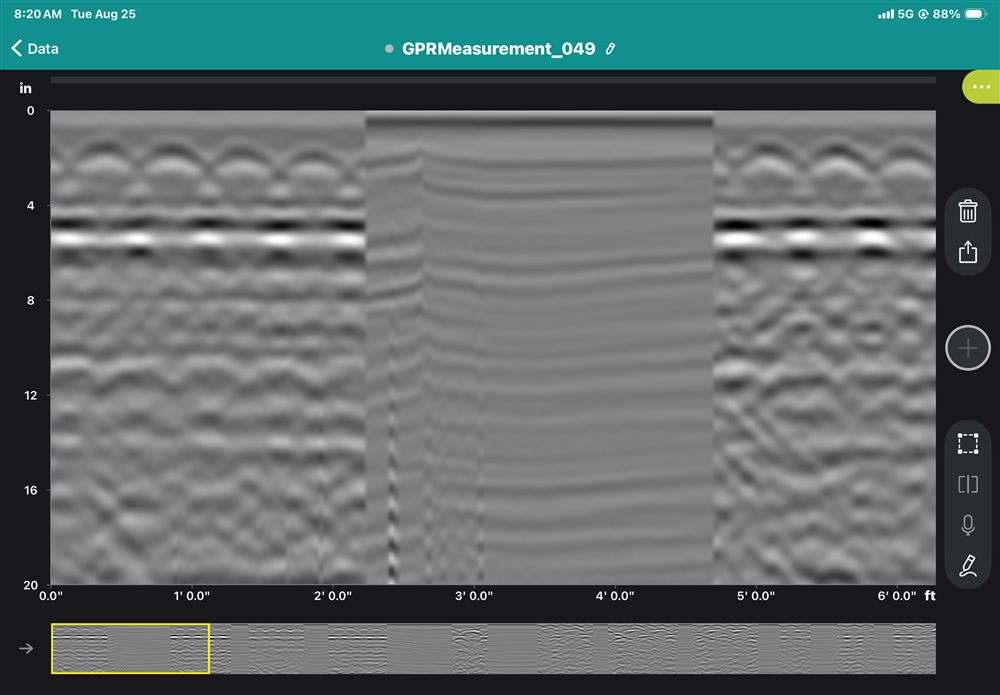
Continuous high-amplitude reflector from 0′0″ to 2′5″ and from 4′8″ to 6′0″. The intervening segment returns no usable slab response.
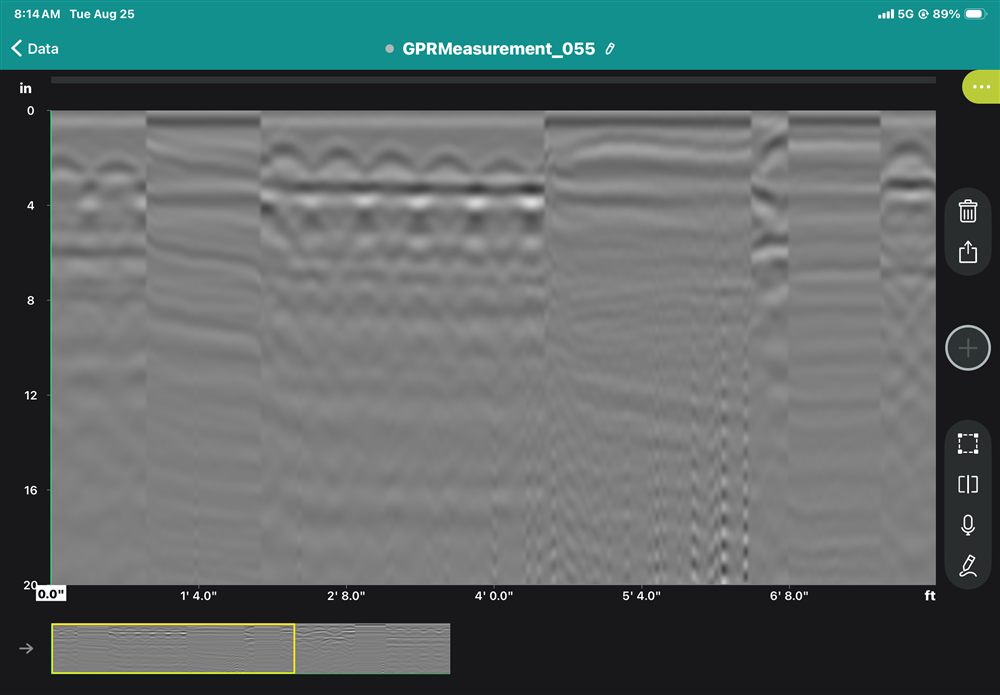
Continuous reflector from approximately 2′0″ to 4′6″; adjacent segments return no usable slab response.
5. Field Recommendations & Operational Rules
Clearance margin: Keep a minimum 1.5-inch buffer from any marked boundary or reference line when coring. Sub-deck caution: Slow down as the bit approaches and penetrates the pan deck; conduit may hang beneath it. The 4-inch perimeter rule: The scanner cannot read within 4 inches of walls, corners, or vertical obstructions; those zones are unscanned and the client assesses that risk. Exclusion zone: Do not drill, cut, or core outside the verified scan boundaries. Report validity: Findings and field markings are valid for 7 days from the date of service.
6. Limitation of Liability & Disclaimer
The contractor uses GPR and other non-destructive methods to identify embedded objects such as rebar, conduit, post-tension cables, and voids. Due to the physical limits of GPR, site conditions, material interference (including signal-blocking steel pan decking, dense mesh, and moisture), and the complexity of concrete, THE CONTRACTOR DOES NOT WARRANT OR GUARANTEE THE ABSOLUTE DETECTION OF ALL EMBEDDED OBJECTS, UTILITIES, ANOMALIES, OR HAZARDS. GPR scanning is an estimation tool, not a guarantee of zero obstructions. The client assumes all risk of proceeding with coring, cutting, or drilling near the scan results, is advised to verify critical areas by other means, and agrees to indemnify and hold the contractor harmless from claims arising from the scanning or the subsequent work. The full text prints with the report; the customer signed the short form on the day of service.
What the customer signed on the phone is the short form. The long form rides on the report. Both were written against Arizona law and both should get a pass from your own attorney before they become your standard.